
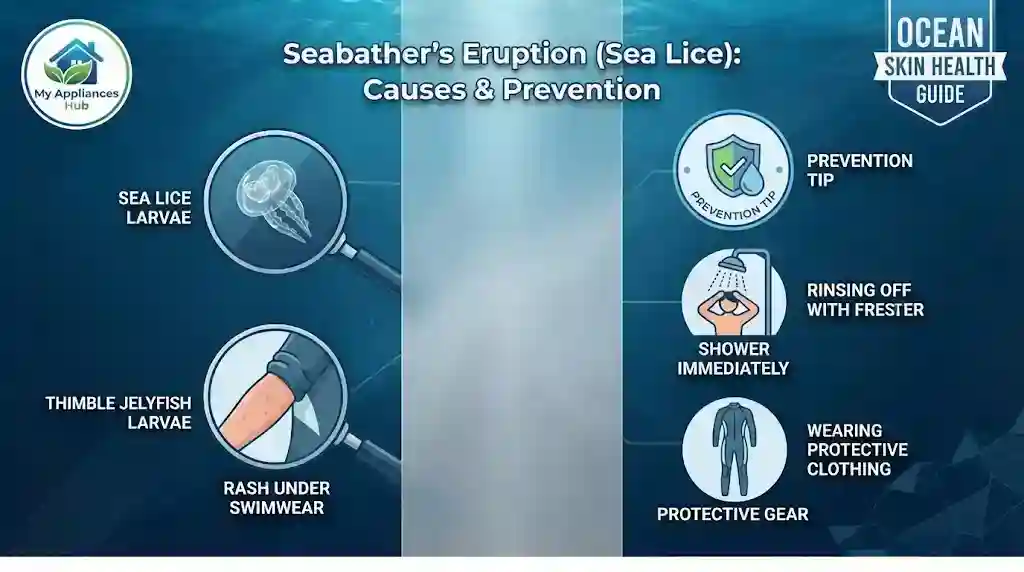
What Is Seabather’s Eruption and How Do You Treat and Prevent It?
Seabather’s eruption (commonly called “sea lice”) is an intensely itchy, red, bumpy skin rash caused when microscopic larvae of thimble jellyfish (Linuche unguiculata) or certain sea anemones get trapped beneath swimwear and discharge stinging nematocysts against the skin. Unlike swimmer’s itch—which occurs on exposed skin in freshwater lakes—seabather’s eruption develops in saltwater and concentrates on skin covered by bathing suits, wetsuits, or hair. Mild cases typically resolve within 1 to 2 weeks using hydrocortisone cream, calamine lotion, oral antihistamines, and cool compresses, while removing swimwear before showering and washing suits thoroughly with detergent prevents further stings.
Complete Guide to Seabather’s Eruption (Sea Lice Rash): Identification, Relief, and Ocean Safety
Developing a sudden, intensely itchy red rash beneath your swimsuit after a day at the beach is the hallmark sign of seabather’s eruption—often referred to by beachgoers as “sea lice.” Rather than true parasitic lice, this saltwater skin reaction is triggered by microscopic jellyfish and sea anemone larvae that become trapped between swimwear fabric and your skin, firing tiny stinging cells as pressure builds or when exposed to fresh water.
While uncomfortable and occasionally accompanied by mild systemic symptoms like fatigue or low-grade fever, most cases can be managed safely at home with targeted over-the-counter relief. This guide covers the exact causes of seabather’s eruption, how to tell it apart from freshwater swimmer’s itch, step-by-step treatments to calm the rash, and practical precautions to protect yourself in warm coastal waters.
(Editorial Note for Fact-Accuracy Refresh: In the raw body text, please clean up several biological contradictions before republishing: clarify that seabather’s eruption is caused by cnidarian larvae [specifically thimble jellyfish, Linuche unguiculata, and sea anemones] in saltwater—not crustaceans or flatworms, and it does not occur in freshwater lakes/rivers; remove the contradictory line claiming “Both cercarial dermatitis and SeaBather’s Eruption are caused by parasitic flatworms”; and emphasize that swimmers must remove their bathing suit BEFORE taking a freshwater shower, because showering with the suit on triggers trapped larvae to discharge more venom.)
Sea lice, which are tiny crustaceans found in seawater, produce the skin ailment known as SeaBathers Eruption. The illness is marked by a red, itchy rash that could result in blistering, swelling, or a burning sensation. While swimming in saltwater where sea lice are present is the most typical way to get SeaBathers Eruption, it can also happen in freshwater. In addition to home remedies like cool compresses and over-the-counter lotions, treatment for SeaBathers Eruption may involve drugs to reduce inflammation and relieve symptoms. Wearing protective clothing and staying away from regions where there are a lot of sea lice are only a couple of the precautions that should be taken to avoid the SeaBathers Eruption.
Related Article
Puriya Wonder Balm Cream for Itchy Skin

CeraVe Moisturizing Cream for Itch Relief/Bug Bites with Hydrochloride & Pramoxine

Rapid Fast Relief Spray – Renews & Restores Skin

Salcura Derma Spray Intensive Natural Skincare Treatment

What Is SeaBathers Eruption?
Sea lice, tiny crustaceans found in seawater, are the source of the skin ailment known as SeaBathers Eruption. The condition is characterized by an itchy, red rash that may also swell or blister. It can also leave the skin feeling burned. Although it can also happen in freshwater, the most typical way to catch it is by swimming in salt water where sea lice are prevalent. In addition to using natural remedies like cool compresses and over-the-counter lotions, SeaBathers Eruption treatment options may also involve using drugs to reduce swelling and relieve symptoms. It is crucial to take precautions, such as donning protective gear and avoiding locations where there are significant sea lice concentrations, to avoid the SeaBathers Eruption.
What Does Seabather’s Eruption Look Like
The larval version of the thimble jellyfish, commonly known as the sea anemone, is responsible for the skin ailment known as the sea bather’s eruption. Intense scratching and the development of red, raised lumps or hives on the skin are the main symptoms of the illness. These lumps, which can form anywhere on the body and mimic a rash or mosquito bites, are most frequently observed on body parts that have been covered by a swimsuit or wetsuit. Blisters may form in extreme circumstances. Usually not dangerous, a sea bather’s eruption can be treated with over-the-counter drugs such as antihistamines or hydrocortisone lotion. After swimming in the ocean, it’s crucial to completely rinse off to get rid of any jellyfish larvae that might be on the skin.
Experts’ Clinical Features of Sea Bather’s Eruption
An allergic reaction to specific parasites that infect various birds and mammals can result in a swimmer’s itch, also known as cercarial dermatitis. Typically, people get it from swimming in freshwater bodies of water like lakes and ponds.
Swimmer’s itch signs and symptoms include:
- A tingling sensation that can be felt either in the water or right after getting out of a wetsuit or other tightly-fitting piece of clothing
- Itching that may become intense and agonizing over many weeks
- A rash with vesicles, red papules, pustules, and urticarial weals could be connected to hair follicles and could also grow dense and run together in a mass.
- Fever, tiredness, and stomach distress are occasionally present.
The rash often develops a few hours after swimming and can last anywhere between one and two weeks on average, although it can linger as long as two months. A past case of a swimmer’s itch may make a person more vulnerable to severe symptoms. The itching could get worse if you take a freshwater shower while wearing a bathing suit.
Causes of SeaBathers Eruption
The primary contributor to the SeaBathers Eruption is a species of sea lice known as thimble jellyfish (Linuche unguiculata). These lice are most frequently seen in the Caribbean and Gulf of Mexico and are found in warm, tropical seas.
The sea lice that cause the ailment are described as:
- Small and transparent thimble jellyfish are challenging to spot underwater. They have tentacles that trail behind them as they swim and are about the size of a thumbtack. They can attach themselves to the skin of divers and swimmers and are generally seen in swarms.
How Lice Adhere to the Skin and Irritate It
- Thimble jellyfish cling to divers’ and swimmers’ skin with the help of their tentacles. Once they have established a connection, they expel a poisonous material that results in an uncomfortable skin rash. The rash can be very unpleasant and is frequently accompanied by redness, swelling, and lumps.
SeaBathers eruption danger factors include the following:
- The likelihood of a SeaBathers Eruption is increased when swimming or diving in regions where thimble jellyfish are known to be abundant. Additional elements that could raise the risk include:
- wearing a wet suit or other items of clothes that offer the lice a favorable surface to adhere to.
- being in the water for extended periods
- Swimming or diving in places where there is a lot of runoff from nutrients or pollutants, can draw in and support large numbers of thimble jellyfish.
Prevention of SeaBathers Eruption:
- It’s necessary to be informed of the existence of thimble jellyfish in the region where you’ll be swimming or diving to prevent SeaBathers Eruption. If you’re going to a place where SeaBathers Eruption is frequent, think about adopting the following safety measures:
- To minimize the quantity of flesh that is exposed to the water, put on a full-body swimsuit or dive skin.
- Avoid diving or swimming in regions where there is a lot of thimble jellyfish.
- To prevent lice from spreading to your skin, use a barrier-forming lotion or spray.
- After exiting the water, rinse yourself with fresh water to get rid of any remaining lice.
Symptoms of SeaBathers Eruption
- A red, itchy rash on the skin is the most typical sign of SeaBathers eruption. Because swimsuits and wetsuits offer a favorable surface for the thimble jellyfish to cling to, the rash is frequently detected on parts of the body that were covered by them. The rash may be itchy to the touch and be accompanied by pimples and puffiness.
- SeaBathers’ Eruption occasionally also results in skin blistering. These blisters may rupture and crust over, and they may be filled with a clear or yellowish fluid.
Other signs that could exist include:
The symptoms of SeaBathers Eruption can include the following in addition to the red, itchy rash:
- the afflicted area swelling
- When touched, the affected area may cause pain or discomfort.
- Fever
- Headache
- Nausea
- Vomiting
- Diarrhea
It’s crucial to remember that the degree of these symptoms might vary and they might not always be present. It’s crucial to get medical help as soon as you can if any of these symptoms appear after swimming or diving in warm, tropical seas.
Diagnosis and Treatment of SeaBather’s Eruption
An itchy skin condition called SeaBather’s eruption, commonly known as sea lice or sea bather’s itch, is brought on by the larvae of specific marine animal species. It is frequently observed in beachgoers after swimming or wading in the ocean and is most frequently detected in regions with warm, temperate waters.
Treatment and diagnosis of SeaBather’s eruption:
- Physical examination: A healthcare professional must conduct a physical examination as the initial stage of the diagnostic procedure. This could entail scanning the skin for indications of redness, swelling, and rash in addition to checking the affected areas for any other abnormalities.
- Skin or tissue samples may be taken in some circumstances by a healthcare professional to pinpoint the precise cause of the eruption. To obtain a sample for laboratory analysis, this may include performing a tiny biopsy or skin scraping.
- Medications: Depending on the severity of the symptoms, a variety of drugs can be used to treat SeaBather’s eruption. These may include oral drugs to lessen inflammation and irritation as well as topical lotions or ointments to calm the skin.
- Home remedies: Several natural treatments of SeaBathers Eruption, in addition to prescription drugs, may be useful in easing the effects of SeaBather’s eruption. A warm bath or shower can also help to calm the skin, as can using aloe vera or using a cold compress on the affected area.
If SeaBather’s eruption symptoms are severe or there is a chance of infection, it is critical to get medical assistance. A healthcare professional can offer appropriate care and advice on how to stop new outbreaks.
Prevention of SeaBather’s Eruption
To minimize the discomfort and probable difficulties brought on by SeaBathers Eruption, prevention is crucial. People can take several actions to lower their risk of acquiring SeaBathers Eruption.
- Wear protective clothing: While in the water, wearing a wetsuit or swim shirt can help to lower your risk of getting SeaBather’s eruption. These kinds of clothing act as a barrier between the skin and the water, which can aid in avoiding contact between the skin and the larvae.
- Avoid regions with a lot of sea lice since SeaBather’s eruption is more frequent there, especially if the water is warm and temperate. Avoid swimming or wading in locations where there are known to be significant populations of sea lice to lower your risk of developing the condition.
- Rinse off as soon as you get out of the water: Rinsing off with fresh water as soon as you get out of the water can help get rid of any larvae that may still be on your skin and stop an eruption from forming.
West Coast of Florida Seabather’s Eruption
The larvae of some marine invertebrates, such as thimble jellyfish, can irritate the skin and cause sea bather’s eruption, also known as sea lice or sea bather’s itch. Cases have also been documented in the Caribbean, along Florida’s west coast, and in Bermuda.
It was first discovered in people who had been swimming off the southeast coast of Florida. Typically, swimmers or divers who come into touch with the larvae will develop this illness because the larvae can emit toxins that can result in an itchy skin rash.
Due to the high number of beachgoers in Florida, it is particularly prevalent in certain regions of the Gulf of Mexico and the Caribbean Sea. Sea bather’s eruption’s specific cause is unknown, however, it is thought to be a recent phenomenon that may be linked to rising beach tourism and the resulting overcrowding of beaches.
Sea bather’s Eruption Vs Swimmers Itch
A skin rash is known as “sea lice” or “sea bather’s eruption” develops after contact with the larvae of some marine species, including thimble jellyfish and sea anemones. A substance that is released by the larvae after they connect to the skin and induce an unpleasant rash.
On the other hand, a swimmer’s itch is a skin ailment brought on by the larvae of specific parasite species that affect animals and birds. The larvae are discharged into the water, where they may come into touch with people and ingest their skin.
Swimmer’s itch and sea bather’s eruption can both be treated with over-the-counter lotions and antihistamines and are commonly encountered in warm, tropical seas. It is advised to avoid swimming in locations where these parasites are known to exist, to take a shower right away after swimming, and to refrain from scratching the affected area to prevent SeaBather’s eruption these problems.
SeaBathers Eruption Vs Cercarial Dermatitis
The skin ailment known as SeaBather’s eruption often referred to as sea bather’s itch or bather’s eruption is brought on by exposure to the larvae of specific marine crab species. These larvae can infect the skin and cause an itchy rash if they get caught in swimsuits or other water-friendly clothing.
Swimmer’s itch, also known as cercaria dermatitis, is a skin ailment brought on by the free-swimming larvae of specific parasitic flatworm species called cercariae penetrating the skin (schistosomes). Birds and snails are frequently affected by the cercariae. The cercariae can worm into human skin when they come into touch with water that has infected snails, leading to an unpleasant rash.
Exposure to organisms from freshwater or marine habitats can result in both SeaBather’s Eruption and cercarial dermatitis, though they are caused by distinct organisms. Both cercarial dermatitis and SeaBather’s Eruption are caused by parasitic flatworms. Also, while the severity and length of the symptoms may be different, they may appear identical. Cercarial dermatitis is more severe, lasts longer, and can result in sores and blisters.
SeaBathers Eruption Frequently Ask Questions (FAQs)
Q: What causes seabather’s eruption (“sea lice”)?
A: Seabather’s eruption is caused by contact with the microscopic larvae of thimble jellyfish (Linuche unguiculata) and certain sea anemones in warm, tropical saltwater—such as off the coasts of Florida, the Gulf of Mexico, and the Caribbean. When these nearly invisible larvae get trapped against the skin under swimsuits, wetsuits, or surf shirts, they release stinging cells that trigger an allergic skin rash.
Q: What is the difference between seabather’s eruption and swimmer’s itch?
A: Seabather’s eruption happens in ocean saltwater and appears primarily on skin covered by swimwear where jellyfish larvae get trapped. Swimmer’s itch (cercarial dermatitis) occurs mostly in freshwater lakes and ponds, is caused by microscopic flatworm parasites from birds and snails, and affects exposed skin not covered by a swimsuit.
Q: Should you shower with your swimsuit on after swimming in sea lice water?
A: No—always remove your swimsuit before rinsing off with fresh water. Fresh water causes trapped jellyfish larvae inside fabric fibers to burst and discharge additional stinging toxins into your skin, making the rash significantly worse. Wash your swimwear with detergent and machine-dry it before wearing it again.
Q: How long does a seabather’s eruption rash last, and how is it treated?
A: Most seabather’s eruption rashes clear up within 4 to 14 days. You can relieve itching and swelling at home with 1% hydrocortisone cream, calamine lotion, oral antihistamines (such as cetirizine or diphenhydramine), and cool compresses, though you should see a doctor if you develop a high fever, severe blistering, or signs of skin infection.
Conclusion: Avoiding SeaBather’s Eruption: Causes, Symptoms, and Prevention
Skin irritation known as SeaBathers Eruption is brought on by the sea lice larvae of some marine organisms. The illness can lead to signs like intense itching, skin redness and swelling, and infection risk. To avoid skin irritability and infection, it’s critical to understand the origins, signs, and prevention of SeaBathers Eruption. People can lessen their risk of getting sea lice by donning protective clothes and avoiding places where the ailment is prevalent. To ensure timely treatment of SeaBathers Eruption and avoid complications, it is crucial to seek medical attention as soon as symptoms appear. People can safeguard themselves from the effects of SeaBathers Eruption by being aware of the possibility and taking precautions.