U.S. B2B Procurement Disclosure: As an Amazon Associate, My Appliances Hub earns from qualifying purchases. This site also displays sponsored advertising (including Google AdSense). Read our Affiliate Disclaimer and Privacy Policy for details on third-party cookie usage and tracking.
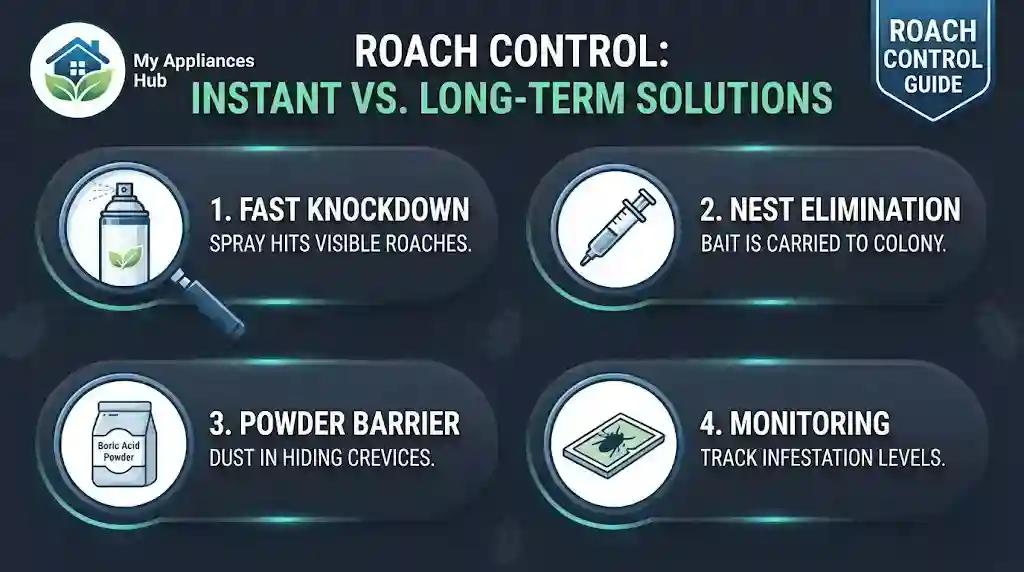
Social media infographic banner for My Appliances Hub titled 'ROACH CONTROL: INSTANT VS. LONG-TERM SOLUTIONS', featuring the official circular logo in the top-left and a 'ROACH CONTROL GUIDE' badge in the top-right against a dark charcoal navy background with subtle cockroach silhouettes. The graphic presents four horizontal rounded cards with circular vector icons: 1. Fast Knockdown ('SPRAY HITS VISIBLE ROACHES.', showing an aerosol spray can inside a magnifying glass), 2. Nest Elimination ('BAIT IS CARRIED TO COLONY.', showing a gel bait syringe), 3. Powder Barrier ('DUST IN HIDING CREVICES.', showing a pouch of Boric Acid Powder), and 4. Monitoring ('TRACK INFESTATION LEVELS.', showing a sticky glue trap).

Fast-Acting Roach Control Guide: Contact Killers vs. Nest-Eliminating Baits

What Kills Cockroaches Instantly—And How Do You Stop The Nest? For immediate contact knockdown, fast-acting pyrethroid aerosol sprays, botanical essential-oil sprays (such as peppermint, clove, or geraniol), and sticky glue traps stop visible cockroaches within seconds. However, because contact sprays only kill the roaches you see and can scatter hidden colonies deeper into walls, lasting

Fast-Acting Roach Control Guide: Contact Killers vs. Nest-Eliminating Baits Read More »
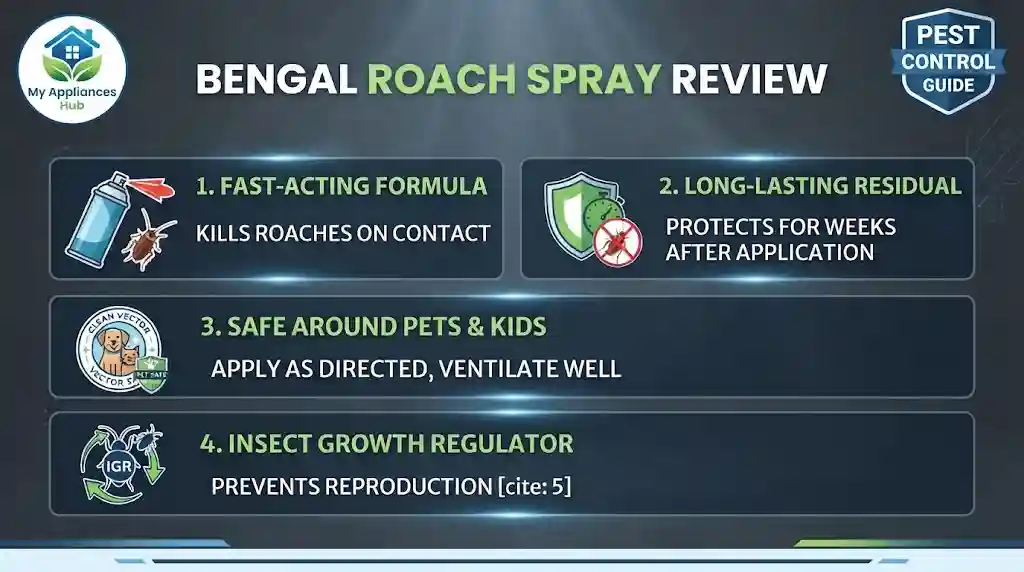
bengal roach spray review social banner

Evaluating Bengal Roach Spray Effectiveness, Safety, Ingredients And Application Tips

Does Bengal Roach Spray Work And How Do You Use It Safely? Yes, Bengal Roach Spray is an effective, fast-acting aerosol insecticide formulated to kill German, American, and Oriental roaches on contact while providing residual protection. Depending on the specific formula (such as standard Bengal or Bengal Gold), it utilizes active ingredients like permethrin, pyriproxyfen

Evaluating Bengal Roach Spray Effectiveness, Safety, Ingredients And Application Tips Read More »

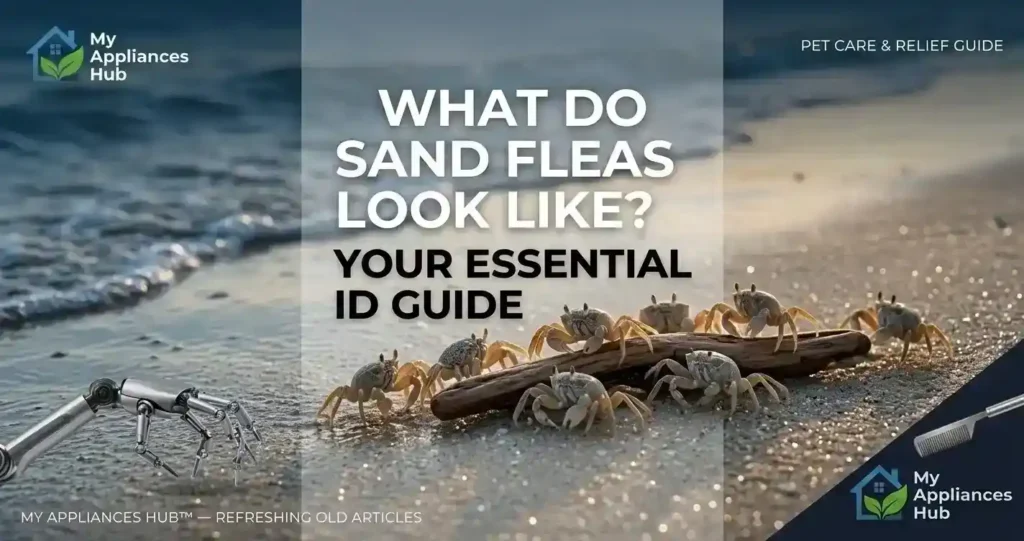
A high-quality social media sharing banner featuring a macro photo of small sand fleas (mole crabs) clustered on a natural driftwood stick along a calm beach shoreline at dusk. The banner includes large white text in the center reading: 'WHAT DO SAND FLEAS LOOK LIKE?' and 'YOUR ESSENTIAL ID GUIDE'. Integrated subtly in the corners are simplified metallic robot-style elements and a fine-toothed comb, next to the My Appliances Hub logo, against the premium beach backdrop[cite: 1, 2].

How To Identify Ocean Sand Fleas (Emerita): Appearance, Colors, And Key Traits

What Do Ocean Sand Fleas (Emerita) Look Like in the Sand? Beaches and coastal waters worldwide host a fascinating variety of marine life, but few organisms spark as much confusion as sand fleas. Whether you have felt something burrowing under your feet in the surf zone or noticed small creatures riding incoming ocean waves, understanding

How To Identify Ocean Sand Fleas (Emerita): Appearance, Colors, And Key Traits Read More »

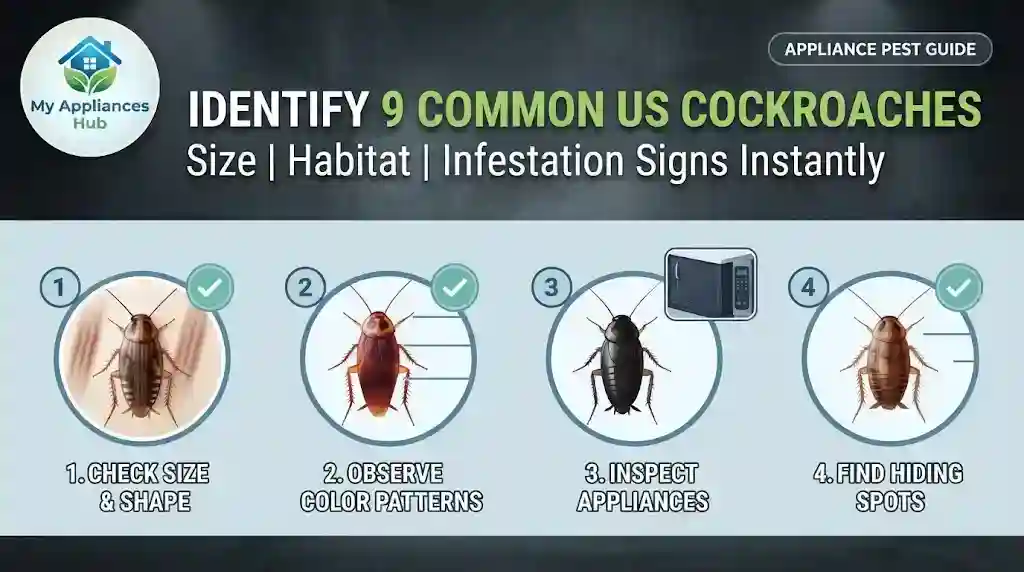
A social media infographic banner for My Appliances Hub titled 'IDENTIFY 9 COMMON US COCKROACHES'. It features the My Appliances Hub logo and four diagnostic steps with circular zoomed-in illustrations: 1. Check Size & Shape, 2. Observe Color Patterns, 3. Inspect Appliances (microwave icon), 4. Find Hiding Spots. The aesthetic is clean, professional, and diagnostic.

9 Common Types of Cockroaches Species In the US: Identification Tips

How Do You Identify the Different Types of Cockroaches in the U.S.? Identifying cockroach species involves examining their size, color, wing structure, and habitat preferences. While thousands of species exist globally, only a few primary types—such as German, American, Oriental, and Brown-Banded cockroaches—commonly invade U.S. homes and appliances. Most feature a flat, oval-shaped body, long

9 Common Types of Cockroaches Species In the US: Identification Tips Read More »

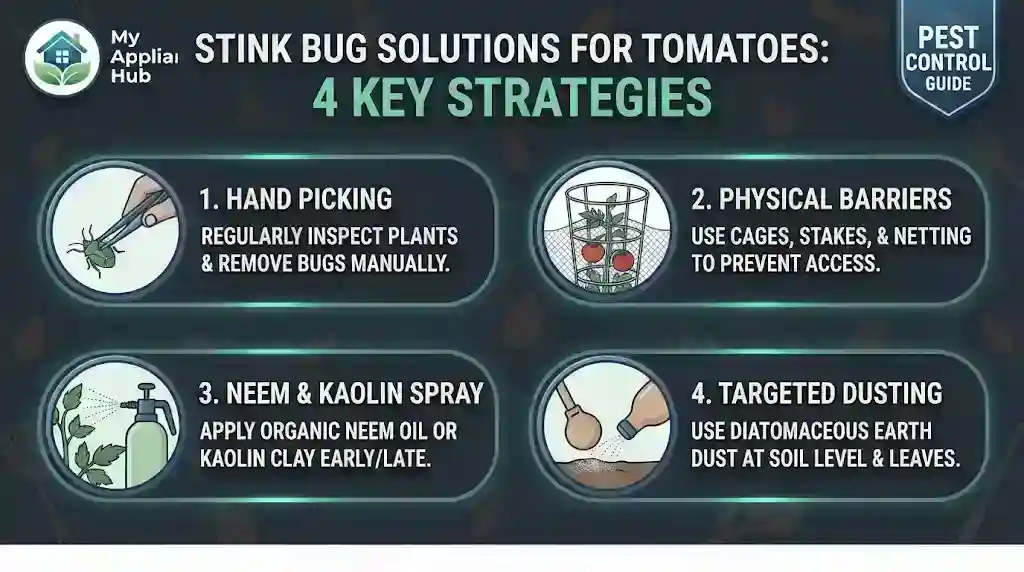
A social media infographic banner for My Appliances Hub, titled 'STINK BUG SOLUTIONS FOR TOMATOES: 4 KEY STRATEGIES' in white and mint green text against a dark charcoal navy background with subtle insect and kitchen silhouettes [cite: 7]. The graphic features a 2x2 grid of rounded panels with glowing cyan borders and circular vector icons: Top-Left: '1. HAND PICKING' with an icon of tweezers removing a green stink bug from a leaf, and text: 'REGULARLY INSPECT PLANTS & REMOVE BUGS MANUALLY.' Top-Right: '2. PHYSICAL BARRIERS' with an icon of a tomato plant inside a wire cage with fine netting, and text: 'USE CAGES, STAKES, & NETTING TO PREVENT ACCESS.' Bottom-Left: '3. NEEM & KAOLIN SPRAY' with an icon of a pump sprayer misting a plant, and text: 'APPLY ORGANIC NEEM OIL OR KAOLIN CLAY EARLY/LATE.' Bottom-Right: '4. TARGETED DUSTING' with an icon of a bulb duster applying powder at the base of a plant, and text: 'USE DIATOMACEOUS EARTH DUST AT SOIL LEVEL & LEAVES.' The My Appliances Hub circular logo is in the top-left, and a 'PEST CONTROL GUIDE' shield is in the top-right [cite: 7].

Tomato Plant Stink Bug Control: Barriers, Sprays, Organic Options & Care

How Do You Stop Stink Bugs From Damaging Tomato Plants? Combine physical barriers and garden hygiene—such as staking/caging plants for airflow, using barrier netting or row covers (uncovering during open pollination if needed), and hand-picking or knocking bugs into soapy water—with targeted sprays like neem oil, kaolin clay barrier films, or insecticidal/dish soap solutions applied

Tomato Plant Stink Bug Control: Barriers, Sprays, Organic Options & Care Read More »

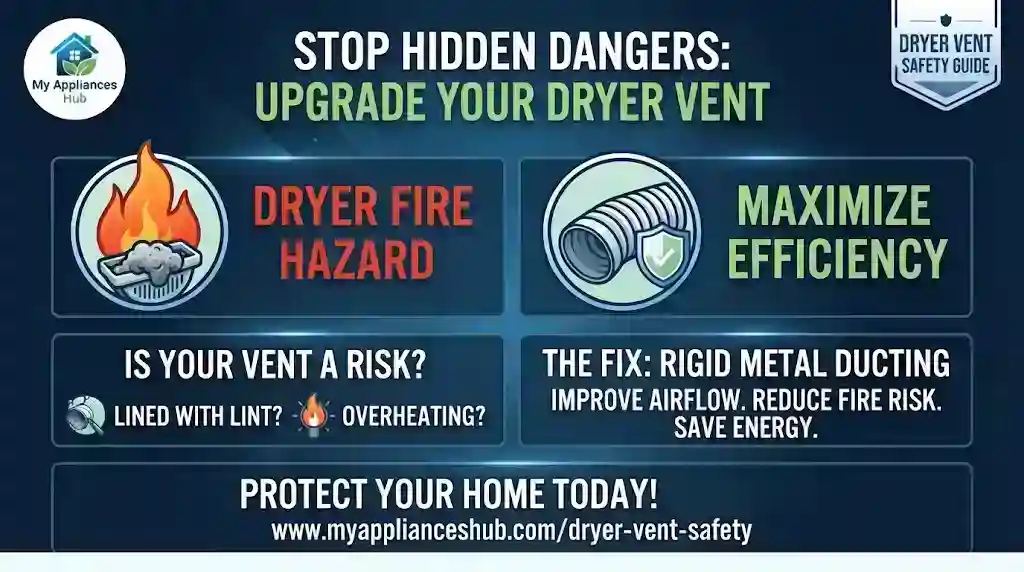
Promotional social media advertisement banner for My Appliances Hub titled 'STOP HIDDEN DANGERS: UPGRADE YOUR DRYER VENT', featuring the official logo and a 'DRYER VENT SAFETY GUIDE' badge against a dark navy background. The graphic compares a 'DRYER FIRE HAZARD' warning panel (with a burning lint trap icon and prompts asking 'IS YOUR VENT A RISK? LINED WITH LINT? OVERHEATING?') against a 'MAXIMIZE EFFICIENCY' solution panel ('THE FIX: RIGID METAL DUCTING — IMPROVE AIRFLOW. REDUCE FIRE RISK. SAVE ENERGY.'), concluding with a bottom call-to-action banner reading 'PROTECT YOUR HOME TODAY! www.myapplianceshub.com/dryer-vent-safety'.

Complete Troubleshooting Guide To Dryer Vent Issues: Symptoms, Causes, Prevention, And Fixes

What Are the Most Common Dryer Vent Problems and How Do You Fix Them? Common dryer vent problems include lint clogs, detached or punctured ducts, crushed or overly long vent runs with too many bends, jammed exhaust flaps, clogged exterior screens, and pest nests—often showing up as damp laundry, long drying cycles, high energy bills,

Complete Troubleshooting Guide To Dryer Vent Issues: Symptoms, Causes, Prevention, And Fixes Read More »

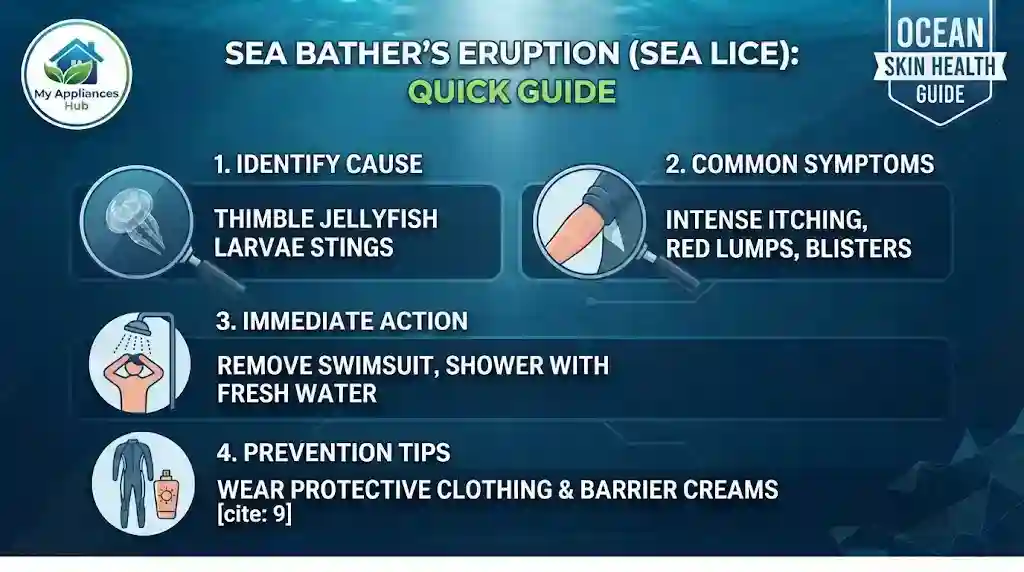
Social media infographic banner for My Appliances Hub titled 'SEA BATHER'S ERUPTION (SEA LICE): QUICK GUIDE', featuring the official logo, an 'OCEAN SKIN HEALTH GUIDE' badge, and four illustrated steps: 1. Identify Cause (thimble jellyfish larvae stings), 2. Common Symptoms (intense itching, red lumps, blisters), 3. Immediate Action (remove swimsuit, shower with fresh water), and 4. Prevention Tips (wear protective clothing & barrier creams)[cite: 9]. The background is a deep ocean blue with light rays.

Complete Guide to Seabather’s Eruption (Sea Lice Rash): Identification, Relief, and Ocean Safety

What Is Seabather’s Eruption and How Do You Treat and Prevent It? Seabather’s eruption (commonly called “sea lice”) is an intensely itchy, red, bumpy skin rash caused when microscopic larvae of thimble jellyfish (Linuche unguiculata) or certain sea anemones get trapped beneath swimwear and discharge stinging nematocysts against the skin. Unlike swimmer’s itch—which occurs on

Complete Guide to Seabather’s Eruption (Sea Lice Rash): Identification, Relief, and Ocean Safety Read More »

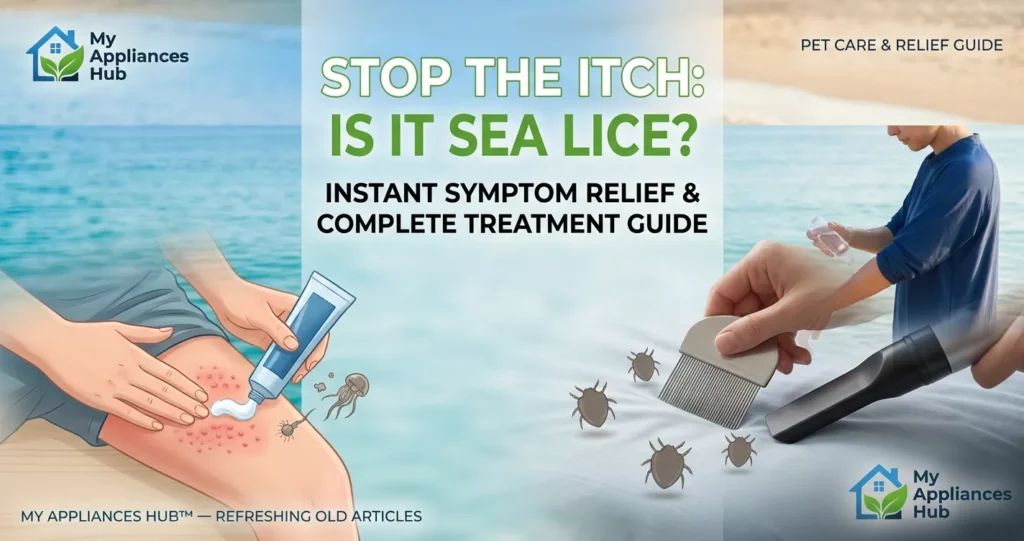
A high-quality social media sharing banner for an article on sea lice rash treatment, featuring prominent text reading 'STOP THE ITCH: IS IT SEA LICE?' over a bright ocean beach backdrop, illustrating soothing topical cream application and freshwater rinsing steps alongside the My Appliances Hub branding.

Sea Lice Bites & Rash: Symptoms, Instant Treatment, and Prevention

What Are Sea Lice Bites And What Actually Causes Sea Bather’s Eruption? “Sea lice bites” (medically known as Sea Bather’s Eruption) are not caused by actual lice, but by microscopic stings from tiny, free-swimming jellyfish larvae (Linuche unguiculata) trapped beneath swimwear. The pressure or fresh water triggers their stinging cells (nematocysts), causing a highly itchy,

Sea Lice Bites & Rash: Symptoms, Instant Treatment, and Prevention Read More »

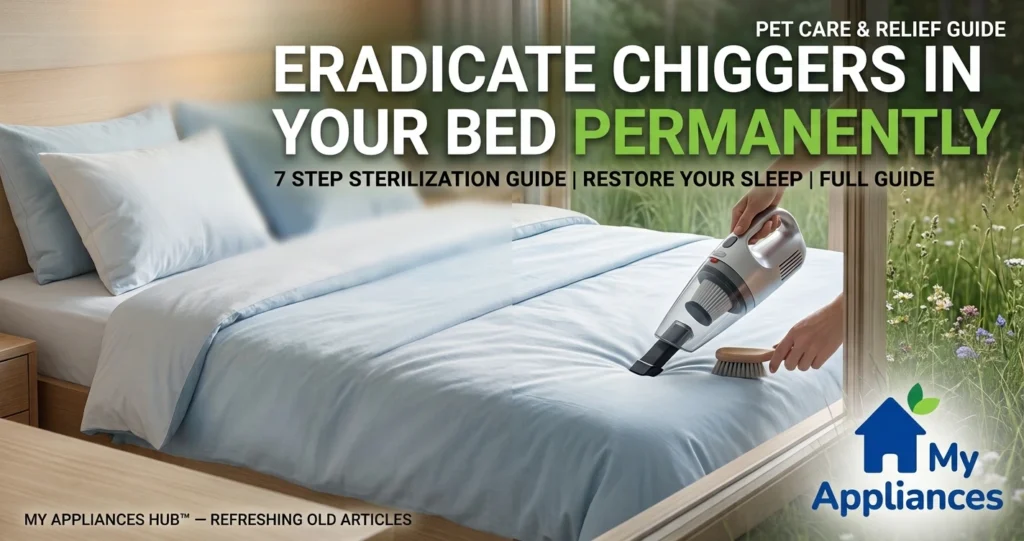
A social media sharing banner designed to promote an article on chigger control. The graphic shows a cozy, clean bed being meticulously cleaned with a hand vacuum and brush, effectively illustrating a key step to eradicate chiggers in the bed permanently, with large white and green text overlay

How to Get Rid of Chiggers in Bed: Complete Removal & Prevention Guide

Can Chiggers Actually Live And Reproduce In Your Bed? Waking up with intensely itchy red bumps after spending time outdoors can make you worry about your sleeping environment. If you suspect chiggers in bed or on your mattress, taking immediate action is essential to stop biting larvae and restore your peace of mind. While these

How to Get Rid of Chiggers in Bed: Complete Removal & Prevention Guide Read More »

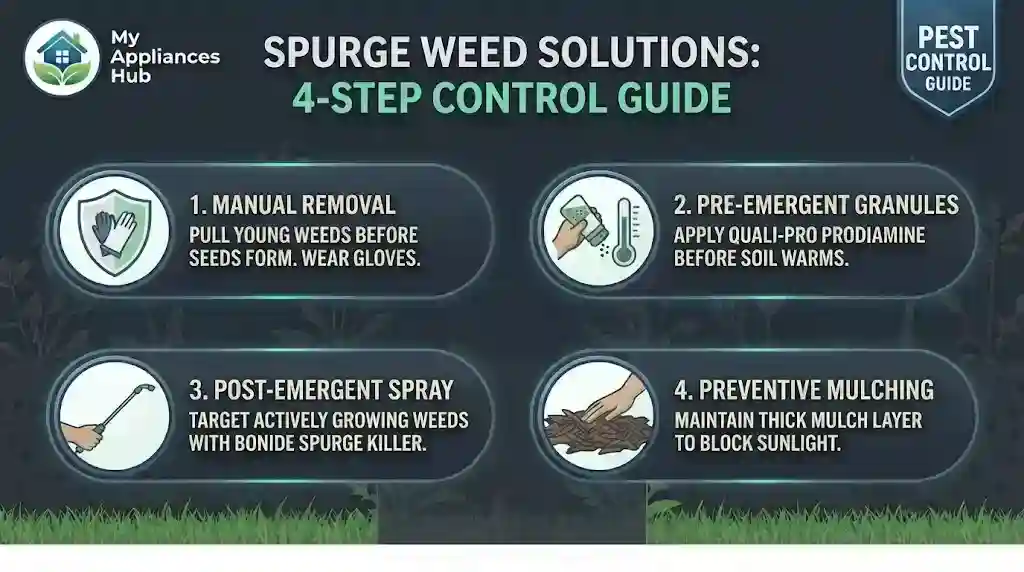
A social media infographic banner for My Appliances Hub titled 'SPURGE WEED SOLUTIONS: 4-STEP CONTROL GUIDE' in white and mint green text against a dark charcoal navy background with a grass border and subtle plant silhouettes. The graphic features the My Appliances Hub circular logo in the top-left, a 'PEST CONTROL GUIDE' shield badge in the top-right, and four rounded horizontal panels arranged in a 2x2 grid with glowing cyan outlines and circular vector icons: Top-Left: '1. MANUAL REMOVAL' with a protective glove inside a safety shield icon and text: 'PULL YOUNG WEEDS BEFORE SEEDS FORM. WEAR GLOVES.' Top-Right: '2. PRE-EMERGENT GRANULES' with a hand shaking granules beside a thermometer icon and text: 'APPLY QUALI-PRO PRODIAMINE BEFORE SOIL WARMS.' Bottom-Left: '3. POST-EMERGENT SPRAY' with a hand holding a sprayer wand icon and text: 'TARGET ACTIVELY GROWING WEEDS WITH BONIDE SPURGE KILLER.' Bottom-Right: '4. PREVENTIVE MULCHING' with a hand spreading wood mulch icon and text: 'MAINTAIN THICK MULCH LAYER TO BLOCK SUNLIGHT.'

Spurge Weed Control: Identification, Pre- & Post-Emergent Options & Sap Safety

How Do You Stop Spurge Weed From Taking Over Your Lawn And Garden? Catch spurge early before it sets seed—applying a labeled pre-emergent herbicide before soil temperatures warm for germination (around 55°F–60°F in spring or in fall before frost) or pulling young plants cleanly from the taproot while wearing gloves and eye protection. Because broken

Spurge Weed Control: Identification, Pre- & Post-Emergent Options & Sap Safety Read More »